
If you’re building a career in grant writing, there is one lesson you’ll hear repeatedly: funders care about results.
Years ago, proposals focused heavily on activities. Grant seekers described what they planned to do, how many people they would serve, and how passionate they were about their mission. Today, that is no longer enough. Funders want evidence that a program creates meaningful change and that the organization can prove it.
As a grant writer, learning how to communicate measurable impact is one of the most valuable skills you can develop. It’s also one of the reasons many organizations turn to GrantWriterTeam to connect with experienced grant writers who understand what funders are looking for. Knowing how to translate a great program into clear outcomes can make the difference between a proposal that gets noticed and one that gets overlooked.
Why You Should Care About Outcome-Driven Funding
Think of yourself as an investor for a moment.
If someone asked you for funding, you would probably want to know what your investment would accomplish. Funders think the same way.
Program officers are no longer satisfied with activity-based proposals alone. They want answers to several important questions:
- What change will your program create?
- How do you know that change is happening?
- How significant is the change?
- Can the results be sustained, replicated, or expanded?
Funders have become increasingly data-focused. They expect organizations to support their claims with evidence. A statement such as “our program improves mental health” sounds positive, but it does not tell a funder how much improvement occurred or how it was measured.
The strongest proposals connect outcomes directly to priorities that matter to funders, such as education, health, housing stability, public safety, workforce development, or economic growth.
Understanding Activities, Outputs, and Outcomes
One of the first concepts every grant writer should master is the difference between activities, outputs, and outcomes.
These terms are often confused, but they serve very different purposes.
| Category | Definition | Examples |
|---|---|---|
| Activities | The actions your organization performs to carry out a program or project. Activities describe the work being done. | • Conducting workshops• Providing tutoring sessions• Offering counseling services• Hosting community events |
| Outputs | The direct products or measurable results of your activities. Outputs show how much work was completed. | • 24 financial literacy workshops delivered• 300 participants served• 500 meals distributed• 100 mentoring sessions completed |
| Outcomes | The changes, benefits, or improvements that occur because of your activities. Outcomes demonstrate impact and are often the primary focus for funders. | • Participants increased their financial literacy scores• Students improved their reading levels• Families achieved stable housing• Job seekers secured employment |
Outcomes demonstrate impact. This is where funders place the greatest attention.
How to Craft Measurable Outcomes
Writing strong outcomes requires precision.
A good outcome statement should leave little room for interpretation. The reader should immediately understand what success looks like and how it will be measured.
Use SMART Goals
Many successful grant writers rely on SMART goals.
Your outcomes should be:
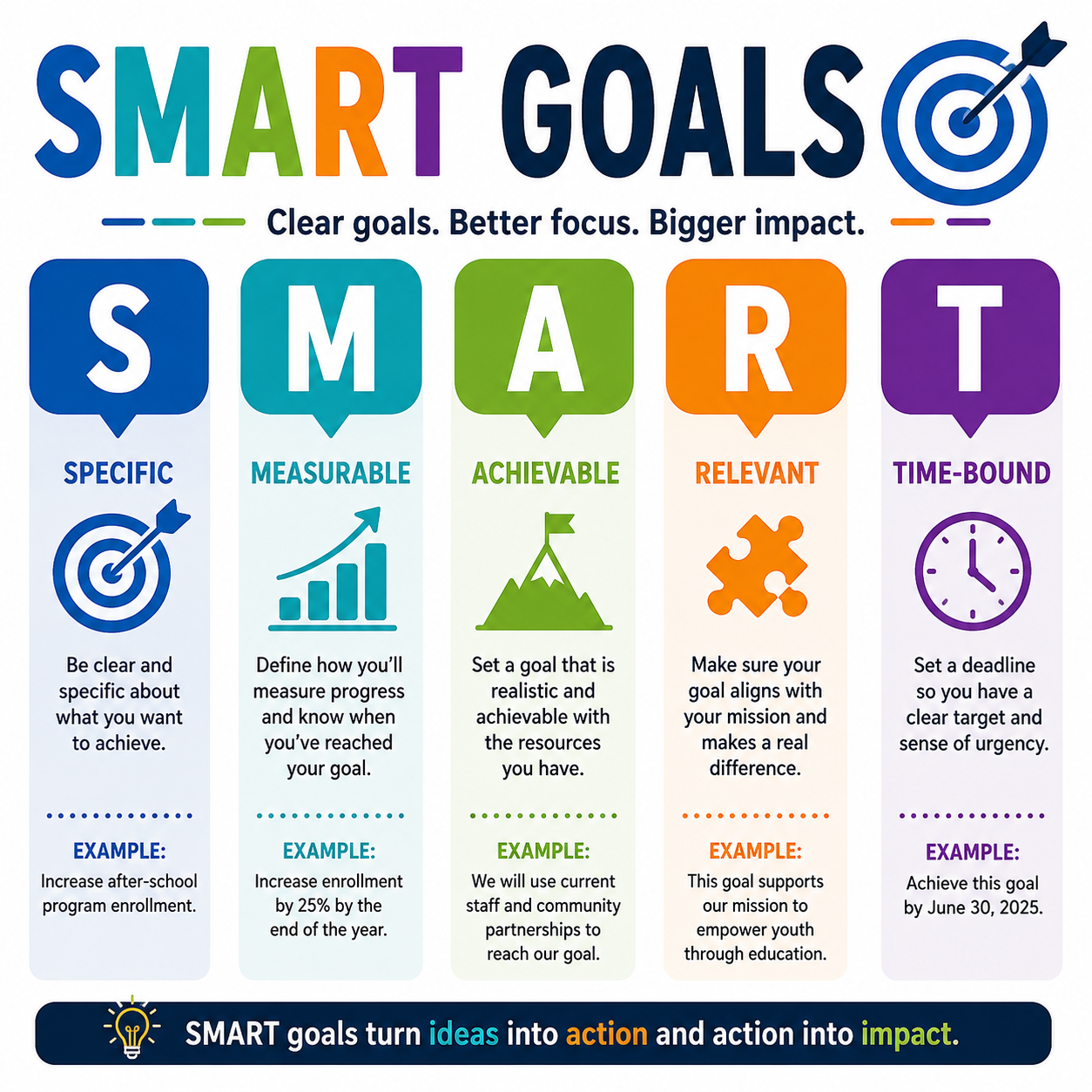
- Specific
- Measurable
- Achievable
- Relevant
- Time-bound
Instead of writing:
“Participants will improve reading skills.”
Write:
“At least 80% of participants will increase their reading level by one grade level by the end of the program.”
The second statement provides a clear target and a measurable result.
Choose Relevant KPIs
Key Performance Indicators, commonly called KPIs, help organizations track progress.
The best KPIs align with both program goals and funder priorities.
Examples include:
- Graduation rates
- Employment rates
- Housing retention rates
- Test score improvements
- Health outcome improvements
When selecting KPIs, always ask yourself: Does this measurement demonstrate meaningful change?
Use Quantitative and Qualitative Data
Numbers tell part of the story.
People tell the rest.
Together, these forms of evidence create a stronger picture of program impact.
Benchmark Your Results
Funders want context.
An 80% success rate sounds impressive, but it becomes even more meaningful when compared to similar programs or national averages.
Benchmarking helps demonstrate that your program is producing exceptional results rather than average outcomes.
Building a Strong Tracking and Reporting System
As grant writers, we often encourage clients to think about data collection before a program begins.
The tool itself matters less than the consistency of the process.
Staff should understand:
- What data to collect
- When to collect it
- How to enter it accurately
- How to protect participant information
Reliable data collection creates confidence in the final results.
Comparing Baseline and Post-Program Data
One of the simplest ways to demonstrate impact is to compare where participants started to where they finished.
This is often called baseline and post-program measurement.
For example:
Before the program:
- Average reading level was third grade.
After the program:
- Average reading level increased to fourth grade.
This comparison shows measurable change.
Without baseline data, it becomes much harder to prove that the program created the outcome being reported.
Transparency Builds Trust
New grant writers sometimes feel pressure to present only positive results.
Experienced grant writers know that honesty builds credibility.
Funders understand that programs face challenges. They appreciate organizations that openly discuss obstacles, lessons learned, and areas for improvement.
Transparency demonstrates maturity and accountability.
In many cases, funders are more willing to support organizations that acknowledge challenges than those that present unrealistically perfect results.
Bringing Data to Life
Numbers matter, but alone, they’re just pins on a map. It’s stories that create connections; the webbing that holds the facts together. The most compelling reports combine data with real-world examples.
Charts, graphs, tables, and infographics help funders quickly understand results. Personal success stories help them understand why those results matter.
A report that says 85% of participants gained employment is powerful.
A report that combines that statistic with the story of a participant who secured a stable career becomes a core memory.
Strong grant writers know how to present both.
The Importance of an Evaluation Plan
Every proposal should include a thoughtful evaluation plan.
An evaluation plan demonstrates accountability, learning, and long-term sustainability.
| Formative Evaluation 🔄 | Summative Evaluation ✅ |
|---|---|
| When it Occurs | When it Occurs |
| During program implementation | After the program concludes |
| Primary Purpose | Primary Purpose |
| Monitor progress and make adjustments | Measure final outcomes and overall effectiveness |
| Focus | Focus |
| Improving the program while it is underway | Assessing the program after completion |
| Key Questions | Key Questions |
| • Are participants engaging with the program? • Are activities being delivered as planned? • What improvements can be made right now? |
• Were the intended outcomes achieved? • Which strategies worked best? • What lessons can guide future programs? |
| Outcome | Outcome |
| Real-time improvements and course corrections | Evidence of impact and lessons for the future |
Include Qualitative Evaluation Methods
Not every result can be captured with a number.
Interviews, focus groups, surveys, and participant feedback can help explain why outcomes occurred and what factors contributed to success.
These insights often provide valuable information for future program improvements.
Budget for Evaluation
Evaluation should not be treated as an afterthought.
Include evaluation expenses in the program budget whenever possible. For larger projects, organizations may benefit from hiring an external evaluator to provide independent analysis and additional credibility.
The Bottom Line
Outcome-driven funding is not a passing trend. It has become a standard expectation across the grantmaking community.
As a grant writer, your job is not simply to describe a program. Your job is to show what will change because of that program and how that change will be measured.
The strongest grant proposals:
- Clearly define expected outcomes.
- Include measurable and trackable indicators.
- Explain how data will be collected and analyzed.
- Demonstrate accountability through evaluation and reporting.
- Use evidence to support future funding requests.
Remember, a compelling narrative may capture a funder’s attention. Measurable outcomes are what ultimately earn their confidence. When organizations can clearly demonstrate impact, they position themselves for stronger relationships with funders and greater long-term funding success.
About GrantWriterTeam
Are you a nonprofit or small business in need of some help? If you are searching for grants but are feeling overwhelmed, hiring a grant writer may be the perfect choice! Grant writers thoughtfully grant opportunities and consider the pros and cons of applying and the chance of success. Consider your writer an extension of your organization. Your grant-seeking success is our priority at GrantWriterTeam.
Disclaimer: There is no guarantee that grants will be awarded as a result of this information.