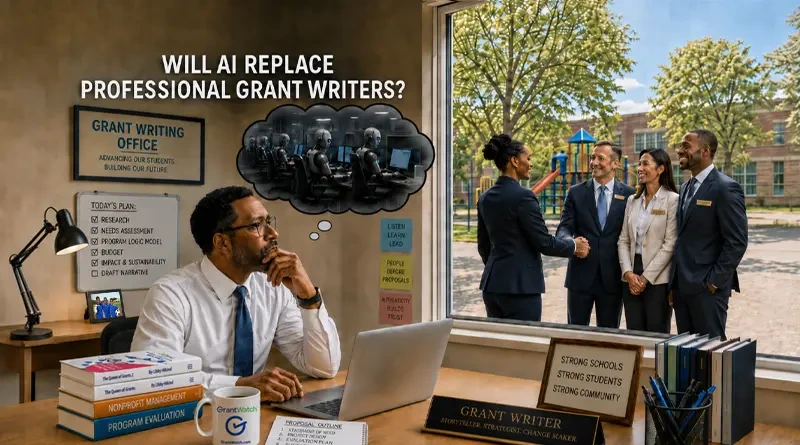
Professional grant writers are increasingly working alongside artificial intelligence tools that can draft, analyze, and organize content at remarkable speed. Yet as AI expands its footprint in the nonprofit world, a critical question emerges: is it a replacement, or simply a powerful assistant? Platforms like GrantWriterTeam give organizations access to a trusted network of grant professionals, collaborative tools, and a supportive environment where grant seekers and writers can connect safely while navigating this evolving digital landscape.
While AI continues to reshape workflows for professional grant writers, it does not eliminate the need for human strategy, storytelling, and funder insight. Instead, it amplifies efficiency while highlighting the irreplaceable value of human judgment in competitive grant environments.
The Rise of AI in Grant Writing
Artificial intelligence has rapidly entered the grant writing ecosystem, transforming how nonprofits approach research, drafting, and compliance. Today’s tools can scan funder databases, summarize eligibility criteria, and even generate initial proposal drafts in seconds.
Many nonprofits are adopting AI to streamline repetitive tasks such as formatting, proofreading, and extracting data from reports. Surveys suggest a growing majority of organizations are experimenting with AI tools to support fundraising and administrative work, signaling a major shift in how proposals are prepared.
However, this acceleration comes with caution. AI-generated content can sometimes produce generic language, inaccurate details, or inconsistencies that weaken credibility in highly competitive grant reviews.
Where AI Helps and Where It Falls Short
AI is especially strong in speed and structure. It can quickly assemble background sections, suggest language variations, and organize large volumes of information. For small nonprofits with limited staff, this can feel like a breakthrough.
But grant funding is not just about information, it is about persuasion, alignment, and trust.
Funders are increasingly alert to submissions that feel overly automated or lacking authentic organizational voice. In fact, many reviewers view heavily AI-written proposals as a potential red flag, especially when narratives feel standardized or disconnected from a nonprofit’s lived impact.
This is where experience becomes essential. Human grant professionals understand nuance: how to align with a funder’s priorities, how to frame impact convincingly, and how to adjust tone for different grant makers.
Why AI Cannot Replace Professional Grant Writers
Even as AI tools evolve, they cannot replicate the strategic thinking that professional grant writers bring to every proposal. Grant writing is not just content generation, it is interpretation, relationship awareness, and alignment with funder expectations.
Experienced writers know how to:
- Translate organizational mission into funder language
- Anticipate reviewer concerns before they arise
- Customize narratives for specific funding priorities
- Build long-term funding strategies, not just single submissions
AI lacks lived context. It cannot understand the subtle differences between funders, nor can it build the trust-based storytelling that often determines whether a proposal is funded or rejected.
This is also where platforms like GrantWriterTeam become valuable, offering access to vetted professionals who combine strategic expertise with real-world funding insight.
The Future: Human Expertise + AI Collaboration
The future of grant writing is collaboration, not replacement. AI will continue to evolve as a support system for research, drafting, and administrative efficiency. But the final shape of a compelling proposal will still depend on human expertise.
Data-driven decision-making is also becoming central to funding success. Funders now expect measurable outcomes, analytics-supported impact statements, and clear reporting frameworks. While AI can help process and organize data, it is human professionals who interpret it meaningfully and connect it to mission-driven storytelling.
The strongest grant strategies will blend both strengths:
- AI for speed and structure
- Humans for strategy and authenticity
- Combined systems for scalability and precision
Conclusion: A Smarter Partnership, Not a Replacement
AI is transforming the mechanics of grant writing, but it is not replacing the role of professional grant writers. Instead, it is redefining their toolkit. The most successful nonprofits will be those that embrace technology while continuing to rely on human insight, creativity, and funder relationships.
Even though the future of grant writing is in flux, the value of professional grant writers remains relevant and essential for turning opportunity into funding success.
About GrantWriterTeam
Are you a nonprofit or small business in need of support? If you’re searching for grants but feeling overwhelmed by the process, hiring a grant writer may be the right solution. Grant writers carefully evaluate funding opportunities, weigh the pros and cons of applying, and assess the likelihood of success. Think of your grant writer as an extension of your organization, working alongside you to strengthen your funding strategy. At GrantWriterTeam, your grant-seeking success is our priority.
Disclaimer: There is no guarantee that grants will be awarded as a result of this information.
Recent Comments